


IBIA’s 2025 integrity report reveals that football and tennis still dominate global suspicious-betting activity
The International Betting Integrity Association (IBIA), the global voice on integrity for the regulated betting industry, has published its annual Sports Betting Integrity Report. It details suspicious betting activity identified across its expanding global-monitoring network during 2025.
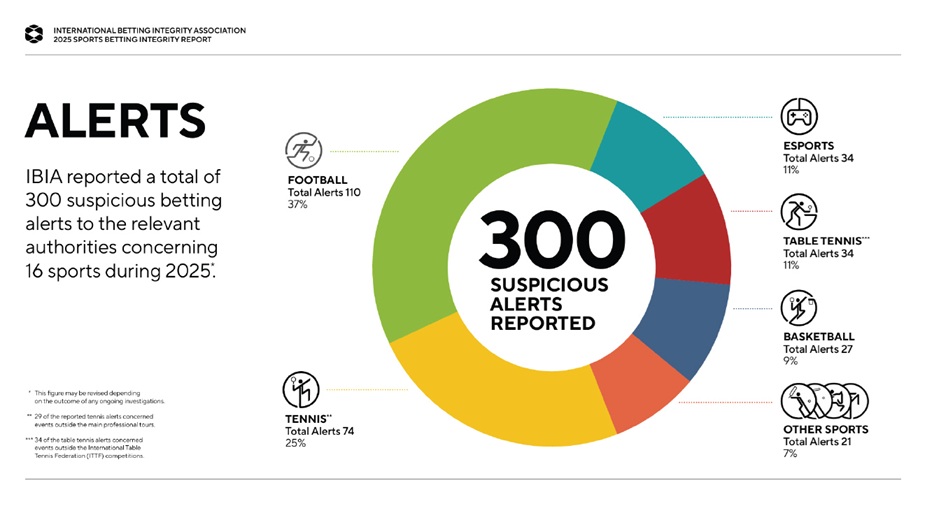
The report records 300 suspicious betting alerts reported to relevant authorities during the year, a 29 percent increase on the 232 alerts reported in 2024. IBIA attributes the rise in part to expanded global-monitoring coverage and enhanced analytical capabilities delivered through its technology platform.
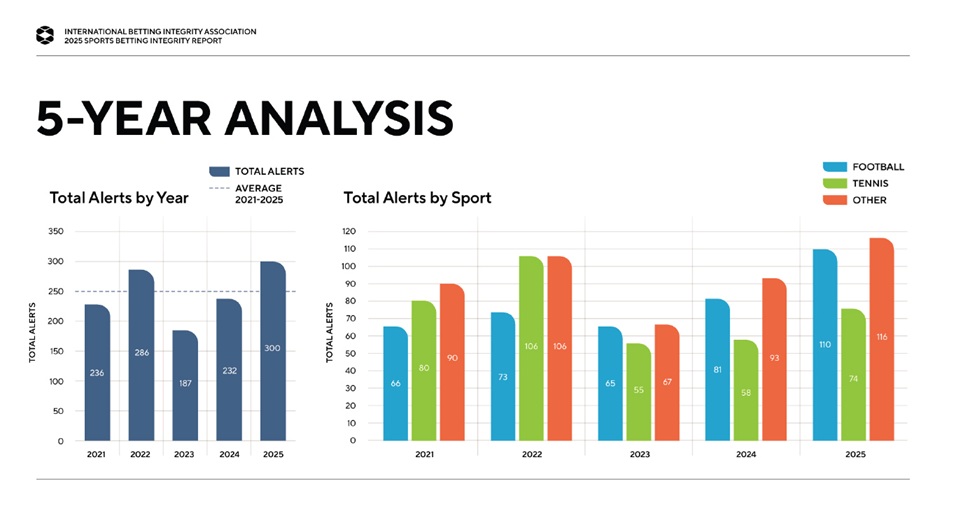
While the headline number has increased, IBIA notes that the overall integrity risk pattern remains consistent. Football and tennis continue to account for the majority of alerts.
Just not Cricket
Of the 300 alerts recorded in 2025, football accounted for 110 cases and tennis for 74, together representing over 60 percent of all reported suspicious betting activity. This concentration mirrors previous years and reinforces the need for continued vigilance in two of the most globally bet-upon sports.
Alerts were reported across 16 sports in total, underlining both the breadth of IBIA’s monitoring capabilities and the diverse nature of contemporary, regulated, betting markets. Beyond football and tennis, IBIA continues to monitor integrity risks in a range of sports where market growth or structural vulnerabilities may elevate exposure. The association stresses that identifying sport-specific risk patterns remains central to targeted preventative strategies.
Operator Intelligence
At the core of IBIA’s integrity framework is its Global Monitoring & Alert Platform (Global MAP). The system monitors over 1.5 million matches annually across more than 80 sports, analyzing transactional data that represents over $300 billion in turnover per year from its member operators.
Unlike purely statistical monitoring systems, the Global MAP is built on account-level data shared directly by licensed operators. This “operator intelligence” provides a strong evidential foundation for investigations and is based on detailed customer-transactional data.
In 2025, IBIA data contributed to 54 matches being proven corrupted, with sanctions imposed on 24 players, teams and officials across five sports. The association’s intelligence was again used extensively by sports-governing bodies and law-enforcement agencies to support disciplinary, as well as criminal proceedings around the world.
For IBIA, operator intelligence is more than simply an investigative tool. Detailed alert data informs the association’s broader prevention strategies. These include policy development, regulatory standards, research initiatives and targeted education programs. By analyzing alert patterns across sports, markets and regions, IBIA is able to identify emerging vulnerabilities and shape proactive countermeasures — from strengthening risk-management protocols to supporting international regulatory dialogue.
Collective Action and Prevention
Commenting on the findings, IBIA CEO Khalid Ali stated that while football and tennis continue to represent the primary integrity risk exposure, the expanded scale and reach of IBIA’s Global MAP has further strengthened the association’s ability to detect, assess, and support investigations worldwide.
“Our 2025 data highlights a familiar integrity-risk pattern, with football and tennis continuing to account for most suspicious betting activity,” said Ali. “At the same time, the greater scale and reach of our Global Monitoring & Alert Platform means our ability to detect, assess and support investigations across markets and sports has increased.
“This is driven by operator intelligence generated by our membership,” he continued, “and their continued commitment to identifying, disrupting, and preventing betting-related corruption through collective action, and information-sharing with our partners.”
IBIA’s operator-intelligence led model remains central to that approach. By pooling transactional data across a growing, global, membership base, the association can identify and disrupt corrupt betting activity more effectively than simple odds monitoring or purely national systems.
As regulated markets continue to develop, IBIA maintains that intelligence-sharing, collaborative enforcement, and preventative education will be fundamental to maintaining consumer confidence and protecting sport, operators, and consumers from betting-related corruption.
*** This article was originally published in Sports Betting Operator Magazine Issue 21 in March 2026***