



With the World Cup, the NFL season and a full Formula One calendar converging, 2026 will be the year sportsbook platforms are tested in public. Three industry voices set out what readiness now means, and where the gap between marketing ambition and engineering reality is widest.
The 2026 sporting calendar arrives carrying outsized commercial expectations. The FIFA World Cup, the NFL regular season and a packed Formula One schedule will push sportsbook traffic, in-play volumes and cross-channel engagement into territory that few platforms routinely handle. For chief revenue officers, this is the moment to convert acquisition spend into lasting value. For engineering teams, it is something rather less romantic. It is an audit.
Sports Betting Operator invited three perspectives to the table.
- Rob Pryce, Chief Revenue Officer at Xtremepush, focused on engagement architecture, single customer data and AI-driven personalisation.
- Matt Howard, Director at Orbital.bet, who has spent his career inside operator and supplier platforms and is candid about the legacy estate that still dominates the sector.
- Luke Campbell, Head of Technology, iGaming at CreateFuture and formerly CTO at Racing & Wagering and PokerStars, who treats peak-event readiness as an engineering discipline problem rather than a marketing one.
The three views do not always agree. That is the point.
Preparing for the Biggest Sporting Calendar
With the 2026 FIFA World Cup, the upcoming NFL season and a packed schedule of Formula One Grands Prix expected to generate record engagement, how are operators and technology partners preparing platforms for the next wave of peak traffic and in-play betting demand?

Rob Pryce, Xtremepush
During a packed sporting calendar, the margin of error during peak acquisition and engagement moments is razor thin. This makes it critical that operators can rely on supplier relationships that they can trust, which stems from a blend of flawless technology and deep industry expertise which knows the sports betting game inside out.
Operators are moving away from transactional vendors and now want to work with teams that truly understand their realities. We position ourselves as “experts in the room” that act as an extension to internal teams, so we can guide on what brands should have in place before a major tournament kicks off, so that they can build that lasting engagement long after the trophy is lifted.
This sits on a foundation of clear communication that allows sportsbooks to have the peace of mind that their masses of data sync without error or delay so that decision makers are seeing a clear, live, and actionable picture of their users, allowing them to confidently turn traffic into major boosts in lifetime value.
Matt Howard, Orbital.bet
The true peaks are what concern the technologies that underpin the sports betting platforms. These are normally seen in small windows of either huge single events, or multiple major events at the same time. The likes of the Grand National horse race in the UK, Superbowl in the US or a Champions League night with multiple major concurrent events have all made the headlines for taking down the sports betting platforms of many an operator (or supplier of operators). The preparation is normally both long-term and very short-term. The long-term being looking at ways of auto-scaling technology to mitigate the risk of unforeseen, or unplanned for, data spikes without needing intervention. Or, where this isn’t a possibility, to beef up the systems capabilities for the expected spike manually.
Luke Campbell, CreateFuture
Major sporting events no longer create isolated “busy days”. They create sustained periods of extreme concurrency, volatile in-play activity and near-zero tolerance for failure.
The strongest operators prepare in three layers.
First, platform resilience. That means aggressive load testing against realistic behavioural patterns rather than synthetic benchmarks. NFL Sundays, World Cup knockout matches and Formula One race weekends all create very different transaction profiles.
Second, operational readiness. Infrastructure scaling alone is not enough. Trading systems, third-party data feeds, payments, PAM integrations, customer support tooling and monitoring all need to be pressure tested, because failures rarely happen in isolation.
Third, architectural simplification. Peak events expose technical debt brutally. Fragile dependency chains, synchronous bottlenecks and ageing integration layers become very expensive very quickly.
The operators who perform best will not necessarily be the ones with the flashiest front ends. They will be the ones whose engineering teams have prepared for failure, designed for graceful degradation, and understand exactly what happens when traffic moves from “busy” to absolute carnage.
The Future of Mobile Sports Betting
Customer expectations around mobile betting continue to evolve rapidly. What innovations do you believe will have the biggest impact on the mobile and online sportsbook experience over the next 12 months?
Rob Pryce, Xtremepush
While you could argue that core sportsbook products and UI has reached a plateau in recent years when it comes to raw functionality, the defining battleground will be around customer experiences. The most impactful innovations will revolve around hyper-personalisation and building those genuine one-to-one relationships that foster deep brand trust.
Players now expect a seamless, continuous journey as they move between devices; this is just a hygiene factor in today’s sports betting space. To capture and retain attention during and after major acquisition events, such as the World Cup, operators must move beyond batch-and-blast communications and tap into progressive messaging that fits with the behaviours found on different channels.
Whether that’s through native, habit-forming gamification, or real-time rewarding, the innovations that develop the sportsbook experience won’t necessarily be obvious from a front-end point-of-view, but will those subtle touches that leverage single customer data, helping users feel understood and valued.

Matt Howard, Orbital.bet
Sports betting has only followed the rest of the world in rapidly moving to a mobile experience. Designing “mobile-first” is probably a decade old term now and for good reason. What should now be the key area of this experience is maximising the experience for customers. This, for me, is in 3 main areas; content management, social experiences and personalisation. There is so much content now within a sportsbook that it is arguably getting in the way of customers experience. Sorting this into manageable portions is a first step to improving that experience. Layering in social and gamified features is something we are beginning to see a new wave of and seems an obvious way, to me, to both stand out and give customers a reason to return. Lastly, the oft-mentioned personalisation point. I’ve seen very little of this which is truly personalised and even less that is intelligently personalised beyond very simple areas like geo.
Luke Campbell, CreateFuture
Customer expectations are increasingly shaped by the best consumer apps in the world, not just other betting operators.
Speed, simplicity and relevance are now the baseline.
Over the next 12 months, I think three areas will matter most.
First, friction reduction. Faster onboarding, cleaner identity journeys, simplified payments and fewer taps between intent and bet placement. Every unnecessary step costs conversion.
Second, meaningful personalisation. Not the usual “recommended for you” lip service, but genuinely smarter experiences based on customer behaviour, preferred markets and how people actually use the product.
Third, richer live experiences. Faster cashout interactions, contextual stats, more intuitive in-play interfaces and smoother real-time engagement across devices.
There is also a broader expectation shift toward always-available mobile experiences. If an app freezes during a key F1 moment or stutters during NFL in-play betting, customers will simply move elsewhere. Mobile is no longer just a channel. For most sportsbook users, it is the product.
AI and Personalisation in Sports Betting
How do you expect AI to influence sportsbook operations, player engagement, personalisation and safer gambling tools during major live sporting events?
This is where the panel diverges most sharply.
Rob Pryce, Xtremepush
AI will not merely influence these areas; it is already fundamentally transforming all aspects of our industry. From a player engagement perspective, we are exiting the era of manual, step-by-step campaign execution and now fully in the age of agentic output.
Solutions, like our XpertOS, demonstrate that true AI innovation is about far more than just operational efficiencies, they’re about scaling reach and deepening relationships, beyond what any existing human team could realistically execute.
Today’s teams only build campaigns for the audiences they can manage, leaving vast amounts of player value untouched. AI, in this example, changes this by autonomously identifying hidden revenue opportunities and drafting hundreds of campaign variants for them, within minutes. Across the board these approaches, when combined with governance and compliance built as a priority within the AI architecture, elevate professionals from task executors to high-level strategists, allowing individuals to focus on holistic brand goals, not just the next campaign build.
Matt Howard, Orbital.bet
As touched on above, I think personalisation is only happening, in sports betting, in very minor and basic ways. I think any operator, or supplier, who really gets this embedded in the experience is going to win. Other online experiences are catered to what the data tells them about customers and, with all the content now within sports betting, they should expect this to be sorted for them here too.
In the case of AI, I’ve seen a lot more in casino and I understand that is because there is a lot less complexity and variance there than in sports betting. Technology owners, be they operators or suppliers, are investigating AI, but I do honestly believe we’re a long way from seeing it having significant impact in sports betting. That said, I think there are some very interesting areas it could work. Lots of decisions in trading and risk management are consistent, and areas like CRM are based on data, so can be looked into heavily.
However, on both points, sports betting technology, as a rule, is not modernised. Many companies run on the same platforms that were built over 20 years ago for a very different business. This legacy technology comes with serious constraints. This is holding back innovation as much as anything else.

Luke Campbell, CreateFuture
AI is one of those areas where the hype occasionally gets ahead of reality, but there are some genuinely transformative use cases for sportsbook operators.
I have long believed that the traditional one-size-fits-all approach to customer experience does little to help operators improve retention or protect margin in an increasingly competitive market.
Customers move between operators more freely than ever. The old assumption that loyalty naturally follows brand familiarity is becoming weaker.
The operators who get true personalisation right, particularly for recreational players, will be the ones who create meaningful long-term differentiation. That means genuinely relevant experiences, smarter content discovery, better recommendations and customer journeys that feel tailored rather than generic.
Of course, that has to be done responsibly and transparently, always asking what is genuinely best for the customer rather than simply what improves short-term commercial outcomes.
Safer gambling is where AI becomes especially compelling.
Pattern recognition at scale can identify behavioural shifts far earlier than traditional rules-based systems, allowing earlier intervention where appropriate. In regulated environments though, AI should augment human decision-making, not replace it.
Explainability, governance and trust will matter just as much as technical capability.
Modernising Betting Infrastructure
Many operators are balancing legacy systems with the need for cloud-native, scalable and compliant platforms. What are the biggest technology challenges the industry still faces when modernising sportsbook and player account management infrastructure?
Rob Pryce, Xtremepush
The most significant technological hurdle the igaming and sports betting industry faces is the ongoing reliance on the complex web of legacy “bolt-on” systems. Stitching together standalone tools creates an incomplete, fragmented picture of data, user behaviour, and a misalignment with the metrics that matter across marketing, trading teams, and the like.
When data is siloed, not accessed from a single hub, time lags occur and real-time personalisation becomes impossible. To modernise effectively, operators must urgently transition toward unified technologies and platforms. This architectural shift is the only way to eliminate lags that erode customer relationships, while allowing all relevant departments to speak the same language at the right time.
Aligned with this holistic approach is the complementary need to deploy next-gen AI tools which automate workflows and scale engagement opportunities safely.
Matt Howard, Orbital.bet
I’ll focus on sports betting technology as that’s my area. As touched on before, the industry rarely runs sports betting on technology under 15 years old. Certainly not at scale. The main problem here has been the complexity of the systems that need to be rebuilt being seen as too much of a task to take on when they are, just about, coping still. The lack of product and technology experience of building a top-class, high-performance sports betting platform is also very rare. So, whilst we do sometimes see newer builds, they are not nearly as strong as the old, legacy ones. The exceptions here would be where completely new modules are needed, or old ones completely fail, and this forces a rebuild.
Luke Campbell, CreateFuture
The biggest challenge is that most operators are not modernising in a clean-room environment. They are modernising while live, regulated, revenue-generating platforms continue operating 24/7.
That changes everything. Legacy sportsbook and PAM estates often contain years of embedded operational logic, commercial workarounds and regulatory adaptations that may be poorly documented but remain absolutely business-critical.
The challenge is not simply moving to cloud or adopting microservices.
It is untangling deeply coupled systems without introducing operational risk. Third-party dependency management remains another major challenge. Operators rely heavily on pricing feeds, data providers, payments, KYC vendors, geolocation services, CRM tooling and external trading integrations. Modernising one layer often exposes fragility elsewhere.
Compliance adds another level of complexity. Architecture decisions must satisfy resilience, performance, auditability and jurisdictional governance expectations simultaneously.
In practice, successful modernisation is less about choosing fashionable technology and more about disciplined engineering execution.
Boring, stable transformation tends to outperform ambitious architectural moonshots in this industry.
Delivering Real-Time Experiences at Scale
Live betting audiences now expect ultra-fast odds updates, real-time data and seamless in-play experiences across every device. What technologies or engineering strategies will be most important in delivering reliable real-time betting experiences during high-volume global sporting events?
Rob Pryce, Xtremepush
Beyond live trading mechanics, delivering real-time marketing and native loyalty experiences is critical for retaining players after expensive acquisitions. Today’s bettors demand instant, personalised gratification. This is what they see in ecommerce and other industries, and this is now required in sports betting.
Bettors expect their loyalty to be recognised immediately, and that’s only amplified during in-play moments. An appeasing email a day after a bad beat is condescending, while a primed nudge a few seconds later builds that relationship quickly, despite forming from a negative experience. This approach is now a must-have, not a roadmap aspiration, and those that can execute it will see those live experiences transform into major lifetime value uplift down the line.
The most vital engineering strategy for this is ensuring real-time loyalty and engagement architecture is in place that can trigger live communications, such as contextual betting nudges, dynamic offers, or tailored gamification prompts, the moment a behavioural signal fires. Legacy solutions fall down at this hurdle too often, and those catching up will only fall behind when it comes to mega events such as this summer’s World Cup.
Matt Howard, Orbital.bet
The industry, in a sense, is creating more problems for itself here by constantly introducing more content. Be that events themselves, or more markets, or even new areas such as esports adding further strain in terms of the sheer volume of data being processed. The sensible thing to do here is to split the system up as much as possible, with modular architecture or splitting services that are running multiple separate types of task. This reduces the pressure on the individual module or service, but also can mean that if one thing fails, it does not bring the entire system crashing down. The most forward-thinking companies are employing cloud-based infrastructure, modern messaging management and upgrading, or even moving entirely, the DB’s to no longer all be based in some central monolith. Technologies like AI are also now forcing product and technology teams to look at how it can be introduced. This is asking questions of the underlying technology and whether it is ready to maximise AI, if not it is also pushing for upgrades which have been pushed down previously.
Luke Campbell, CreateFuture
Real-time betting at scale is fundamentally an engineering discipline problem.
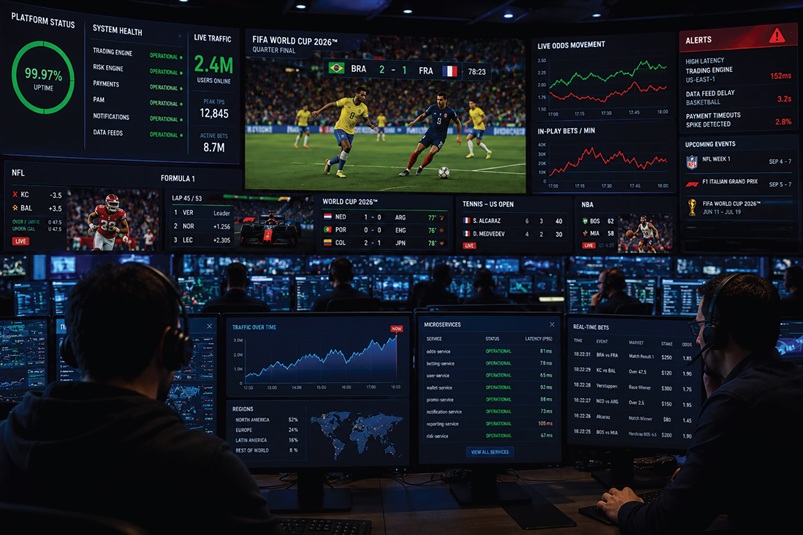
Customers see fast odds updates, instant interactions and seamless in-play betting. Underneath that sits a fairly unforgiving combination of event streaming, low-latency processing, pricing engines, caching strategy and resilient front-end delivery.
A few areas matter most.
Event-driven architecture is critical for handling rapid state changes efficiently. Intelligent caching and edge delivery become essential when huge volumes of customers want access to the same rapidly changing data simultaneously. Observability is massively underestimated. During live sporting events, teams need immediate visibility into latency, degradation and failing dependencies before customers notice.
Graceful degradation strategy is equally important. If one component struggles, the entire customer journey should not collapse with it. And finally, engineering culture matters as much as tooling. The strongest platforms are usually run by teams who rehearse failure scenarios, understand their bottlenecks and treat resilience as a core product feature. During major sporting events, customers do not care whether your architecture diagram looks elegant.
They care whether the bet goes on in time.
The Final Whistle
Three voices, three vantage points, one calendar. Pryce sees the year as an engagement and lifetime-value test, with AI moving from assistant to operator. Howard, plainly, sees a sector still running on platforms older than most of its players, and warns that the AI conversation runs ahead of the infrastructure beneath it. Campbell sees an engineering discipline problem that rewards preparation, observability and graceful degradation over architectural ambition.
By the time the final whistle blows on the World Cup, the sector will have learned which operators built for the moment and which simply hoped for it. The receipts will not be in the marketing recaps. They will be in the latency graphs and the retention curves.
Thank you to Rob, Luke and Matt, for sharing their views and insights.
*** This exclusive interview was originally published in Sports Betting Operator Issue 022 May 2026 ***