


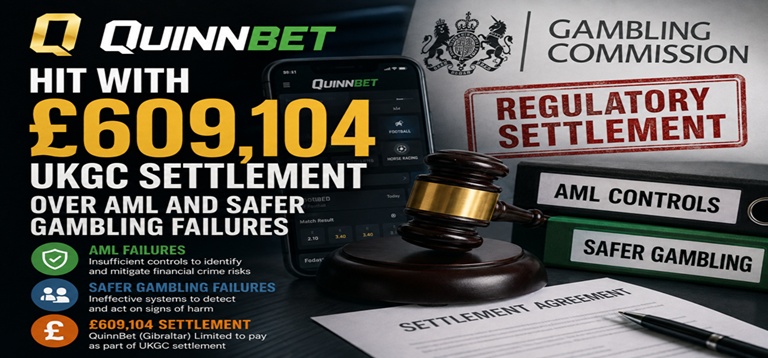
24 August 2026 | QuinnBet (Gibraltar) Limited has agreed to a £609,104 regulatory settlement with the UK Gambling Commission (UKGC) after a compliance assessment uncovered shortcomings across its anti-money laundering (AML) and social responsibility controls.
The settlement, announced on 20 August, relates to the operator behind quinnbet.com and includes a payment in lieu of a financial penalty, publication of a statement of facts and a contribution towards the regulator’s investigation costs. Of the total, £193,118 represents disgorgement, with the money being directed to the UK Government’s Consolidated Fund.
The UKGC said the regulatory review followed a compliance assessment of QuinnBet’s remote operating licence and found breaches covering AML and counter-terrorist financing, remote customer interaction and financial vulnerability checks.
Customer protection controls failed to identify high-risk behaviour
Among the most serious findings were weaknesses in QuinnBet’s systems for identifying signs of potential gambling harm.
The Commission found that indicators including high deposits, short high-velocity sessions, increasing stakes, betting frequency and high turnover were not always captured and sent for manual review.
In one case, a customer placed approximately 4,800 bets in a single day and 7,000 the following day without the activity being identified and flagged.
The regulator also highlighted a separate case in which a customer, following a large win, went on to stake more than £215,000 in a single day, including multiple wagers above £5,000. The activity was not identified until a report was produced the following morning.
The Commission said most risk indicators were fed into reports that were not generated in real time. Those reports were generally produced the next morning, with reviews taking place afterwards. On rare occasions, staffing pressures could mean some accounts were reviewed another day later.
The UKGC said this meant the operator did not always identify or act on indicators of harm quickly enough.
Young customers able to exceed lower deposit limits
The investigation also identified problems with QuinnBet’s controls for customers aged between 18 and 24.
QuinnBet had recognised that young adults could be more vulnerable to gambling harm and had introduced lower deposit limits for the group. However, before its platform migration, those limits relied on a manual process and could take several hours to become active.
The Commission said one young adult was able to deposit eight times their intended monthly deposit limit before the restriction was applied, subsequently losing the entire amount within a day.
The regulator separately found that a platform migration resulted in errors affecting deposit-limit controls. Human and software-update errors caused two controls to fail on some accounts, allowing 194 customers to deposit and potentially lose funds above their intended limits.
The case also exposed shortcomings in financial vulnerability checks. Between February and May 2025, some customers who had reached the relevant threshold were not checked at the intended time.
When the missed checks were subsequently conducted, the Commission found that 41 customers would have failed the check and 136 would have required account restrictions.
£9,000 loss despite £2,000 monthly income
The UKGC’s AML findings provide another indication of the scale of the control weaknesses.
The Commission said QuinnBet did not always have sufficient controls to identify and mitigate disproportionate spending quickly.
In one example, a customer supplied payslips showing monthly earnings of approximately £2,000, yet was able to deposit and lose £9,000 within four days.
In another case, a customer deposited approximately £120,000 and withdrew £111,000 over a period of less than three months. Although the customer provided a bank statement and tax return, neither showed transactions with QuinnBet.
The Commission said QuinnBet had assumed the funds were recycled winnings but had not obtained evidence establishing that this was the case.
The operator was also found to have insufficient controls to ensure that Suspicious Activity Reports (SARs) were submitted as soon as practicable once the threshold for suspicion had been reached.
Regulatory review covered more than two years
The UKGC’s public statement says the AML/CTF failings occurred between March 2023 and August 2025, while the remote customer-interaction failures occurred between October 2023 and August 2025.
The financial vulnerability check failures identified by the Commission occurred between February and May 2025.
The regulator said the case involved breaches of Licence Condition 12.1.1, covering money laundering and terrorist financing controls, alongside multiple provisions of Social Responsibility Code Provision 3.4.3 covering remote customer interaction and SRCP 3.4.4 concerning financial vulnerability checks.
QuinnBet has held its UK Gambling Commission remote licences since September 2022, with its current licence record showing active casino remote, real-event betting and virtual-event betting permissions.
The Commission confirmed that this was the operator’s first regulatory enforcement action. It also identified a number of mitigating factors, including QuinnBet’s cooperation, early voluntary reporting of some failings, acceptance of the issues at an early stage and the rapid implementation of a remedial action plan.
QuinnBet says issues have been resolved
QuinnBet CEO Brenda Quinn said the operator had acted following the Commission’s compliance assessment in March 2025.
The company said it strengthened its policies, procedures and controls and invested significantly in people and technology. According to QuinnBet, the improvements were subsequently reviewed by the Commission and the issues identified were resolved to its satisfaction.
QuinnBet said it considers the regulatory matter fully resolved and remains committed to customer protection, compliance standards and further strengthening its systems and controls.
The UKGC, however, used the case to issue a broader warning to the gambling sector.
UKGC: Controls must work in practice
John Pierce, Gambling Commission Director of Enforcement, said the QuinnBet case demonstrated the consequences of relying on systems and controls that cannot respond quickly enough to indicators of gambling harm and financial crime.
The regulator stressed that operators need safeguards that work effectively in practice, rather than simply having policies and procedures in place.
The Commission’s public statement also calls on operators to review their own systems, particularly around disproportionate spending, Source of Funds checks, SAR reporting, platform migrations, deposit limits, harm-detection algorithms, real-time intervention and automated responses to strong indicators of harm.
That emphasis on implementation is significant for sportsbook operators, as the UK Gambling Commission findings show that failures can arise even where an operator has formal policies and controls documented.
Another warning shot for UK sportsbooks
QuinnBet’s settlement comes amid continued enforcement activity from the UK Gambling Commission.
The regulator’s enforcement register shows a series of recent actions against gambling operators, including a £900,000 settlement with Petfre (Gibraltar) Limited in June, a £4.75 million settlement with Evolution Malta Holding Limited in July, and a £150,000 penalty against Holland Park Leisure Limited in August.
For sportsbooks and online gambling businesses, the QuinnBet case adds another clear message from the UK regulator: customer-interaction, AML and financial-risk controls are being judged on their ability to identify and respond to real customer behaviour within an appropriate timeframe.
The most striking examples in the QuinnBet investigation — thousands of bets going undetected, more than £215,000 staked in a single day without timely intervention, and a customer losing £9,000 despite declared monthly income of around £2,000 — demonstrate the potential consequences when monitoring systems fail to keep pace with customer activity.
The £609,104 settlement therefore represents more than a financial sanction. It is another warning to the wider betting industry that regulatory compliance increasingly depends on whether operators’ technology, processes and people can intervene when risk emerges — not simply whether those controls exist on paper.