

Nevada’s regulated sports betting sector is facing mounting competitive pressure as prediction markets continue to expand across the United States, prompting leading sportsbook executives to publicly acknowledge the growing impact on traditional wagering operators.
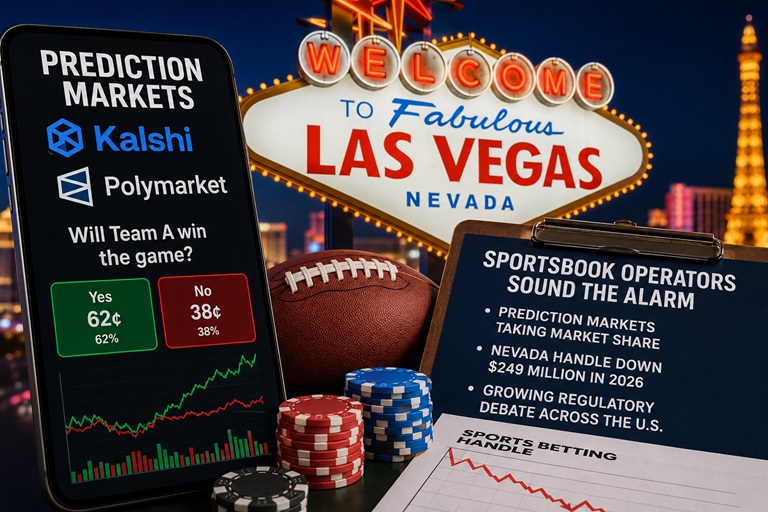
The discussion comes at a time when Nevada sports wagering handle has reportedly declined by approximately $249 million during the first half of 2026 compared with the same period last year, intensifying concerns over changing consumer behaviour and the emergence of alternative betting products.
During a recent hearing before the Nevada Gaming Control Board, senior executives from Boomer’s Sportsbook and Caesars Digital highlighted prediction markets as an increasingly significant competitive challenge. According to CDC Gaming, Hall of Fame bookmaker and Boomer’s Sportsbook CEO Joe Asher argued that prediction markets are taking market share from licensed Nevada sportsbooks, while Caesars Digital President Eric Hession agreed that the sector is beginning to affect sportsbook revenues.
Their comments reflect a wider debate taking place across the US gaming industry as prediction market platforms continue to expand their offering on sporting events alongside political, financial and real-world event contracts.
Unlike traditional sportsbooks, prediction markets generally operate under financial market regulations rather than state gaming laws, creating an increasingly complex competitive and regulatory environment. This distinction has become a major point of contention for licensed sportsbook operators, many of whom argue they face significantly higher compliance costs, taxation and regulatory oversight than companies offering similar products under different regulatory frameworks.
The issue is rapidly becoming one of the defining regulatory discussions within the North American betting industry. Operators, regulators and lawmakers continue to debate where the boundary lies between financial event contracts and sports wagering, with several states already challenging the legality of certain prediction market products.
For sportsbook operators, the implications extend well beyond Nevada. If prediction markets continue to gain consumer acceptance while remaining outside traditional gaming regulation, licensed operators could face increasing pressure on betting volumes, customer acquisition and long-term profitability.
The comments made before Nevada regulators underline what many within the industry have been discussing privately for months—that prediction markets are no longer viewed as a niche product but as a genuine competitive force capable of reshaping the US betting landscape.
As regulators continue to examine the evolving market, the relationship between licensed sportsbooks and prediction market operators is likely to remain one of the most closely watched developments in the North American gaming sector throughout the remainder of 2026.