


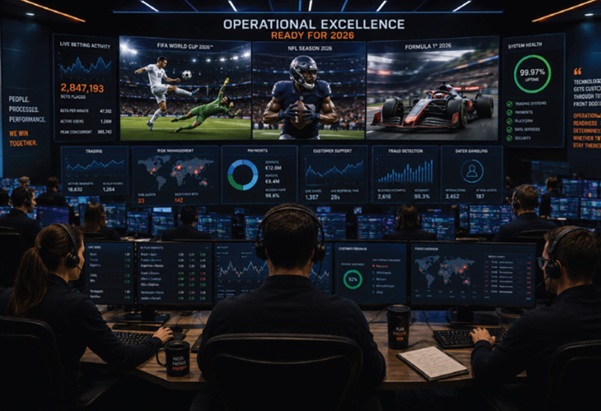
As the Fifa World Cup, NFL season and F1 calendar converge on a single year, former Sporting Group CEO Andy Wright tells Sports Betting Operator why the operators who win 2026 will be those whose people and processes hold up under pressure, not those with the newest stack.
The 2026 sporting calendar is unusually loaded. A World Cup, a full NFL season with continued international expansion, and an F1 grid drawing record audiences. For every Tier 1 sportsbook, the operational pressure is about to be tested in public.
Sports Betting Operator caught up with Andy Wright, former CEO of Sporting Group and a veteran of nearly three decades in regulated international betting and gaming, to talk through major-event readiness, the real role of AI, the difficulty of platform transformation, and the question he’d ask first when the dust settles on the World Cup final.
With the World Cup, the NFL season and the F1 calendar all landing in 2026, where does a sportsbook come under most strain at peak? And what separates the operators that cope in-play from those that don’t?
The biggest misconception is that major sporting events are primarily a technology challenge.They aren’t.
I’ve been through enough World Cups, Cheltenham’s and Grand Nationals to know that while operators understandably focus on platform scale, it’s rarely the technology that determines whether they succeed or fail. Most operators already know where their technical bottlenecks are. What catches them out are the operational ones.
Trading teams making decisions under pressure. Payment’s volumes spiking. Customer service queues growing. Risk teams dealing with unusual patterns of activity. Fraud teams seeing behaviours they didn’t anticipate.
Technology gets customers through the front door. Operational readiness determines whether they stay there.
The operators that perform best aren’t necessarily the ones with the newest technology stack. They’re the ones that prepare properly, test thoroughly and have a plan for when things inevitably go wrong.
I’ve seen operators spend millions upgrading technology only to discover the biggest bottleneck was an operational process they hadn’t looked at for years. Major sporting events have a habit of exposing those weaknesses very quickly.
Mobile is now the default rather than the differentiator. Over the next year, which single capability do you think will genuinely improve the in-play experience, rather than just sounding new?
Relevance. The industry has spent years adding more markets, more content and more functionality. At some point, more becomes noise. Customers don’t want hundreds of additional betting options. They want to get to the moments that matter to them as quickly as possible. Whether that’s delivered through personalisation, smarter navigation or better use of data, the operators that reduce friction will have an advantage. The best customer experiences often feel simple. That’s usually because a lot of hard work has happened behind the scenes.
In my experience, customers rarely remember the feature you added. They remember how easy—or difficult—you made it for them to do what they wanted to do.
AI is being attached to everything from pricing to personalisation to safer gambling. Where does it add real value in the sportsbook this year, and where is the hype running ahead of reality?
The industry has a habit of overestimating what technology will achieve in the short term and underestimating what it will achieve in the long term. AI feels a little like that today. There are clear areas where it already creates value. Customer operations, fraud detection, safer gambling and personalisation are all obvious examples where automation and pattern recognition can make a measurable difference.
Where the hype runs ahead of reality is the idea that technology can replace experience. The best operators I’ve worked with weren’t successful because they had the most technology. They were successful because they had the best people making the best decisions. That’s why I don’t see AI as a replacement for expertise. I see it as a tool that helps experienced people make better decisions faster. If we get that balance right, it will be transformational. If we think it removes the need for expertise, we’ll be disappointed.
A lot of operators are still running on ageing core systems. What is the hardest part of moving to cloud-native platforms without disrupting live trading?
In most transformations, the technology isn’t what keeps me awake at night. It’s everything around it. The processes, controls and ways of working that have built up over years are usually far harder to change than the platform itself. In most operators, the platform isn’t just a piece of technology. It’s the backbone of how the organisation functions. Replacing it means changing workflows, responsibilities, reporting lines and sometimes culture. I’ve been involved in large-scale transformations and integrations throughout my career, and one lesson keeps repeating itself: technology projects rarely fail because of the technology. They fail because organisations underestimate the complexity of change.
In-play customers now expect odds to track the action with no lag, on any device. What matters most for keeping latency low and reliability high when millions are betting on the same moment?
Preparation and resilience.
Customers only see what happens on match day, but reliability is determined months beforehand. Architecture matters. Infrastructure matters. Monitoring matters.
But the real differentiator is whether you’ve genuinely prepared for peak demand and unexpected issues. The operators that perform consistently well are usually the ones that assume things will go wrong and plan accordingly.
Because if you’ve been in this industry long enough, you know perfect doesn’t exist. The goal isn’t to eliminate every issue. The goal is to identify problems quickly, respond effectively and minimise the impact on customers. When millions of customers are reacting to the same sporting moment, resilience becomes a competitive advantage.
And to finish. When the World Cup final ends, what will separate the operators who had a good tournament from the ones who merely survived it?
Most operators will immediately look at turnover, revenue and acquisition numbers. They’re important. But they’re not the first numbers I’d be looking at.
The first question I’d ask is simple: did the business perform under pressure?
Major sporting events expose weak processes, fragile systems and poor communication faster than almost anything else. They reveal the truth about how an organisation really operates. The operators that come out strongest won’t necessarily be the ones with the biggest revenue spike They’ll be the ones that delivered a consistently good customer experience, kept their teams performing under pressure and emerged better prepared for the next major event. That’s usually the sign of a well-run business.
And in my experience, well-run businesses tend to win more often than they lose.
***Sports Betting Operator would like to that Andy Wright for his time and high level of cooperation with this feature***
 About Andy Wright
Andy Wright is an international betting and gaming executive with almost three decades of leadership experience across sportsbook, gaming and retail operations.
A former CEO of Sportting Group, Andy has held senior leadership roles with FDJ United, Tabcorp, Ladbrokes, Betclic Everest, Stan James and Blue Square, working across publicly listed, private equity-backed and high-growth organisations. Throughout his career, Andy has led large-scale transformation programmes, organisational change initiatives and operational improvement projects across regulated international markets, building a reputation for combining strategic thinking with strong execution. He is recognised for his expertise in business transformation, customer experience, commercial performance and the practical application of technology and automation to improve operational effectiveness.